USPTO Update: Eleven Months into the New Administration (November 2025)
The U.S. Patent and Trademark Office (USPTO) has undergone significant changes in the first year of the new administration, led initially by Interim Director Coke Morgan Stewart and now by Director John Squires. The general themes of the new administration have centered on being pro patent owner and patentee rights, loosening Section 101 examination, and reducing the Patent Trial and Appeal Board (PTAB) invalidation rates of U.S. patents. This article examines these efforts and the impact to date.
Backlog
Over the last 7 years, the backlog of unexamined Utility, Plant, and Reissue applications (UPR) has grown from 522,149 in 2018 to 788,229 as of September 2025.
To help speed up prosecution and reduce this backlog, the USPTO reduced examiner time allocated for non-examining functions, including eliminating examiner-industry education programs beginning in the Spring of 2025. The Office more recently limited examiner credit for interviews with applicants to one, single-hour interview per application round. Essentially the goal was to have examiners focus only or primarily on issuing office actions.
While the USPTO was quick to announce in September 2025 that it had reduced the backlog from 837,000 applications to 794,000 (USPTO Touts Declining Patent Backlog, Eyes Bigger Drop - Law360), Figs 1 and 2 below from the PTO’s statistics dashboard, indicate that this reduction was temporary (Fig. 1), and the average inventory has only decreased slightly over the last year (from 793,824 to 788,229). Fig. 2.
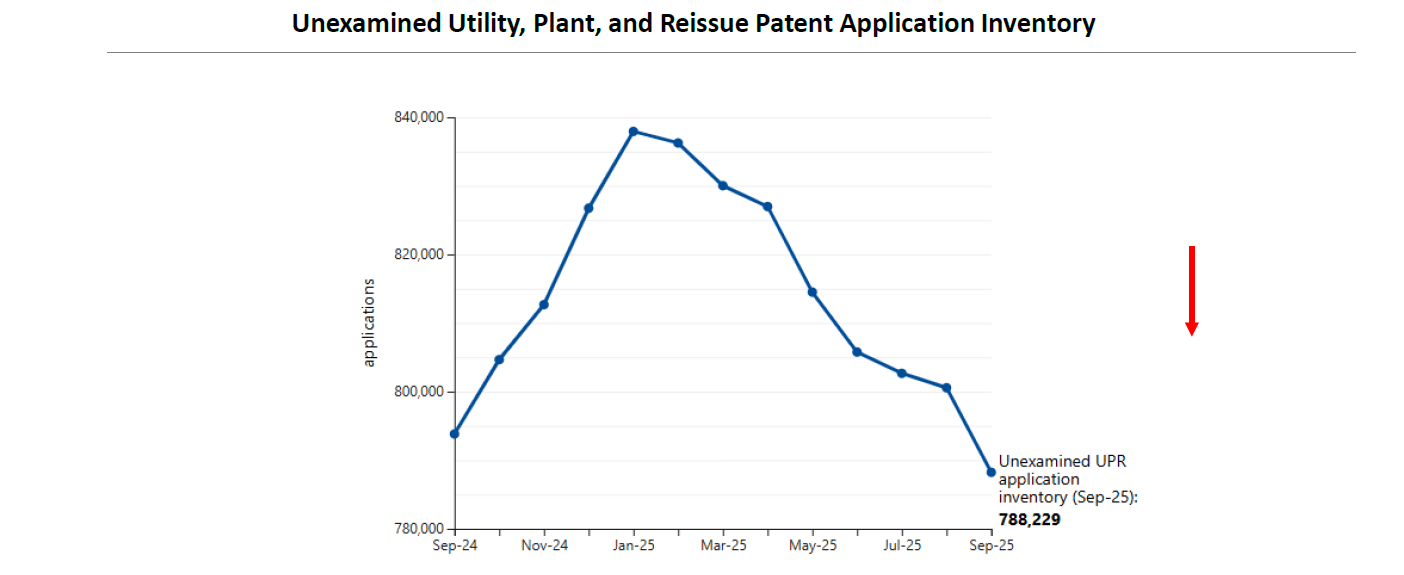
Figure 1
 Figure 2
Patents Dashboard | USPTO; In fact, the average application pendency until a first Office Action has actually increased from 19.9 months in 2024, to 22.6 months in 2025, according to USPTO data. Fig. 3.
 Figure 3
These results can be attributed in part to the difficulty in expanding the examining work force. As of March 2025, the USPTO employed 8,516 patent examiners, a slight decrease from 8,599 in FY 2024. The decrease is partly due to a federal-wide hiring freeze implemented in early 2025 and pressure to cancel examiners’ ability to work remotely, which has complicated efforts to recruit and retain staff. The USPTO had set an initial goal to hire over 1,600 new examiners for Fiscal Year 2025, but the hiring freeze and high attrition rates have hindered this goal, leading to a net reduction in the total number of examiners. Nevertheless, the fact that the Office was able to reduce the temporary spike of 837,000 applications by 50,000 in less than a year suggests that it has the ability to output first Office Actions at a rate that should continue reducing the backlog over the next few years.
Patent Eligibility (35 U.S.C. § 101)
Director Squires has also made clear his view that prior PTO examinations involving 35 U.S.C. § 101 were too restrictive and that more types of inventions should be patentable.
In a Memorandum dated August 4, 2025, Deputy Commissioner for Patents Charles Kim instructed examiners to differentiate between claims that “recite” a judicial exception (e.g., naming an algorithm) from those that merely “involve” one, a key distinction at Alice Step 2A, Prong One. He also warned against broadening the “mental process” category to cover what cannot practically be done in the human mind and re-emphasized the claim-as-a-whole analysis at Prong Two, specifically for technological improvements.
Then on September 26, 2025, Director Squires convened an Appeals Review Panel (ARP) that vacated a PTAB Section 101 rejection against AI-related claims. The ARP cited Enfish, LLC v. Microsoft Corp., emphasizing that “claims directed to an improvement in the functioning of a computer... are patent eligible”.
Following the August 4 memo and the Desjardins decision, the PTAB reversal rate of examiner Section 101 rejections doubled from 10% to 20%.
In parallel to the PTO efforts to reduce Section 101 rejections, Congress is working on the Patent Eligibility Restoration Act (PERA), a bill intended to eliminate all judicially created exceptions to patent eligibility. This bill has bipartisan support and has passed the Senate Judiciary Committee but is awaiting a full Senate vote.
Say Goodbye to Inter Partes Review (IPR)
In his Senate Judiciary confirmation hearing on May 21, 2025, Director Squires testified that patents “…have a 68% defect rate; if the American patent system was a factory, 68% of the products we put out are found defective in a later proceeding.” He promised that “[h]aving improved quality, I think, will alleviate many concerns…” But rather than strengthening the examination process to improve the quality of patents, he has simply eviscerated the process that invalidates them. Together with Interim Director Stewart, Director Squires has increased the use of Director discretion to deny institution of most IPR petitions. These decisions are not appealable pursuant to 35 U.S.C. § 314(d). Nevertheless some petitioners have challenged discretionary denials via Writs of Mandamus in the Federal Circuit, based on constitutional arguments like due process (retroactive application of the new policy) and separation of powers (exceeding authority or violating the Administrative Procedures Act via application of the "Settled Expectations" doctrine). To date, none have been successful, and as of this writing, the Federal Circuit has dismissed the due processes challenges.
The end result is that IPR institution rates have fallen from the nearly 70% average to the 40% range. Figs. 4 and 5.
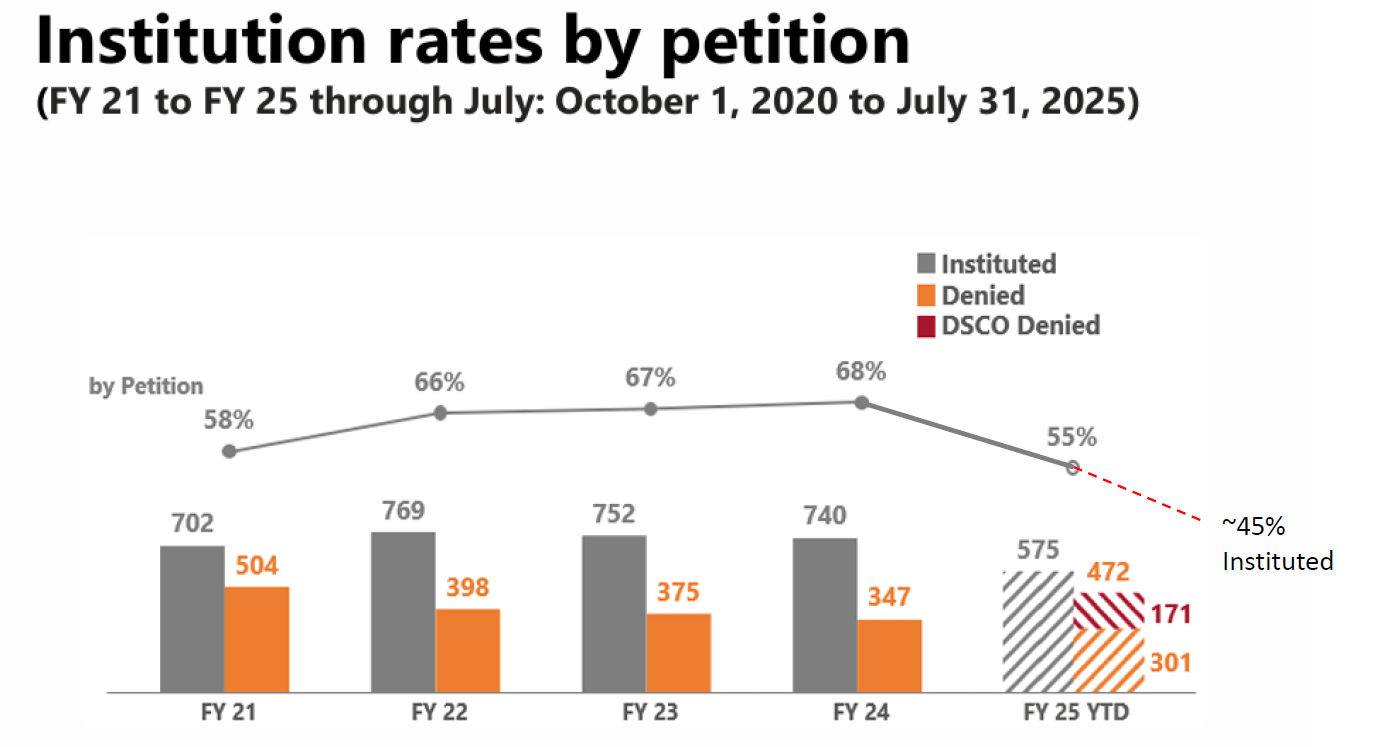
Figure 4
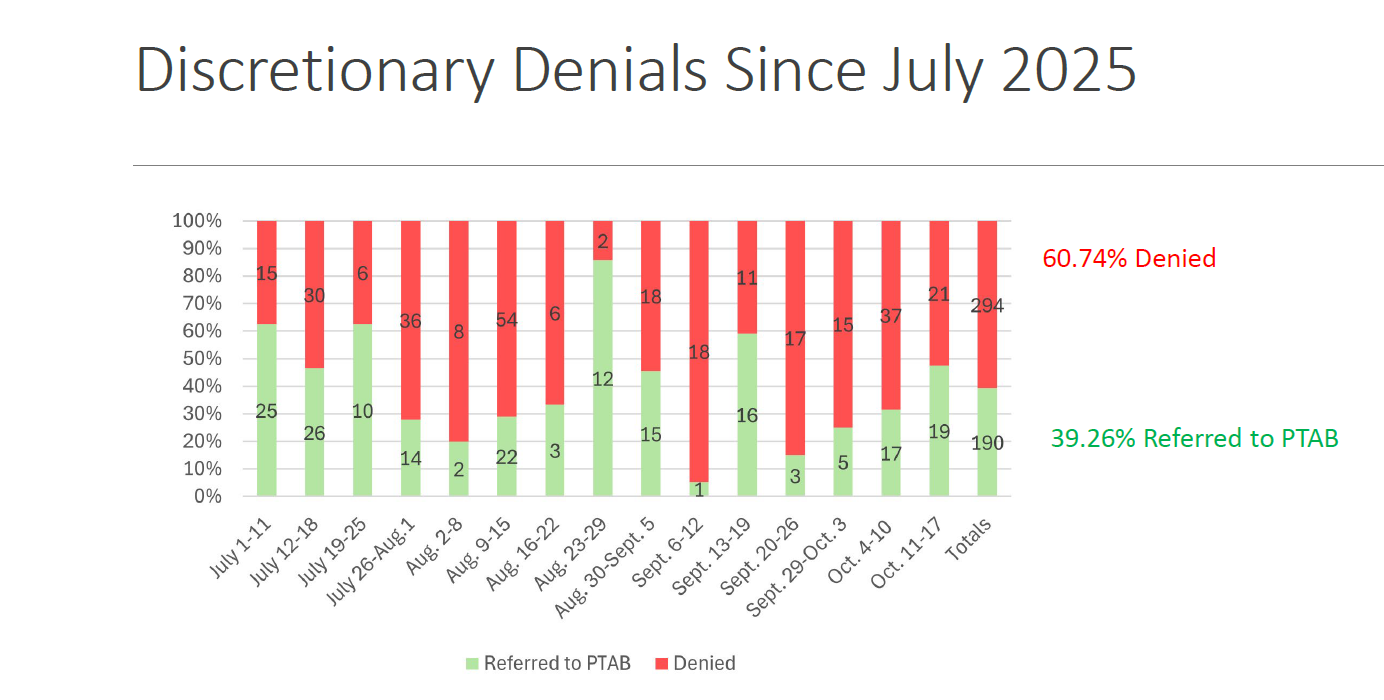
Figure 5
As shown in Fig. 5, from July 1 through October 17, 2025, a total of 294 IPR petitions (60%) were denied on discretionary grounds, and only 190 (39%) were referred to the PTAB for a merits decision.
The USPTO also issued a Notice of Rulemaking on October 16, 2025, proposing new rules that would reduce PTAB challenges even more. If enacted, the new rules would:
- Require the challenger to agree not to make any prior art invalidity arguments in other venues.
- Extend estoppel to prior art based on products, uses, and sales/offers.
- Prohibit PTAB from reviewing patents that have ever been adjudicated anywhere by any challenger, or where another proceeding would reach a decision first.
These proposed rules have public comments due by November 17, 2025. If implemented, they will certainly further reduce the use of IPRs. Also effective October 17, 2025, Director Squires took over all IPR and Post-Grant Review (PGR) Institution Decisions. He will decide all cases in consultation with three PTAB judges, addressing both discretionary denial issues and the merits.
Most potential petitioners recognize that IPR institutions will now be limited to patents that are less than six years old, where there is no other trial likely to happen before the PTAB decision is due.
Conclusion
So as we approach the beginning of 2026, we can see the patent landscape for the next three years taking shape. The application backlog still exists, but there are signs that there could be some progress reducing it over the next few years. Software companies can be optimistic that Section 101 examinations will be more lenient. But IPR challenges, previously the most common and powerful tool that an accused infringer had to defend against an overly broad patent assertion, will be rarely used.